
Will it Etch? is our monthly series on what’s possible with photochemical etching, one material at a time.
Kovar does one thing. It matches the thermal expansion of glass.
That’s it. It’s not the strongest metal you can spec. It’s not the most conductive. It’s not cheap, and it’s not easy to machine. But if you need a metal-to-glass or metal-to-ceramic hermetic seal that won’t crack when the temperature swings, Kovar (ASTM F15) is the answer, and it has been since the mid-20th century. The alloy is roughly 29% nickel, 17% cobalt, balance iron, with a coefficient of thermal expansion (CTE) around 5 ppm/°C. That’s nearly identical to borosilicate glass and close enough to alumina ceramics to form reliable, repeatable hermetic bonds.
You’ll find it inside vacuum tubes, semiconductor packages, electrical feedthroughs, satellite connectors, x-ray tubes, and anywhere else a seal has to be airtight and survive thermal cycling. If the application is hermetic and high-reliability, odds are good there’s Kovar in the assembly.
What makes Kovar tricky to work with
Kovar work-hardens aggressively. Every pass of a cutting tool makes the next cut harder, which accelerates wear and pushes tolerances out of spec. Carbide tooling wears fast, chips are long and stringy, and the alloy’s low thermal conductivity concentrates heat right at the cutting edge, compounding all of it. Machinability is poor by any standard.
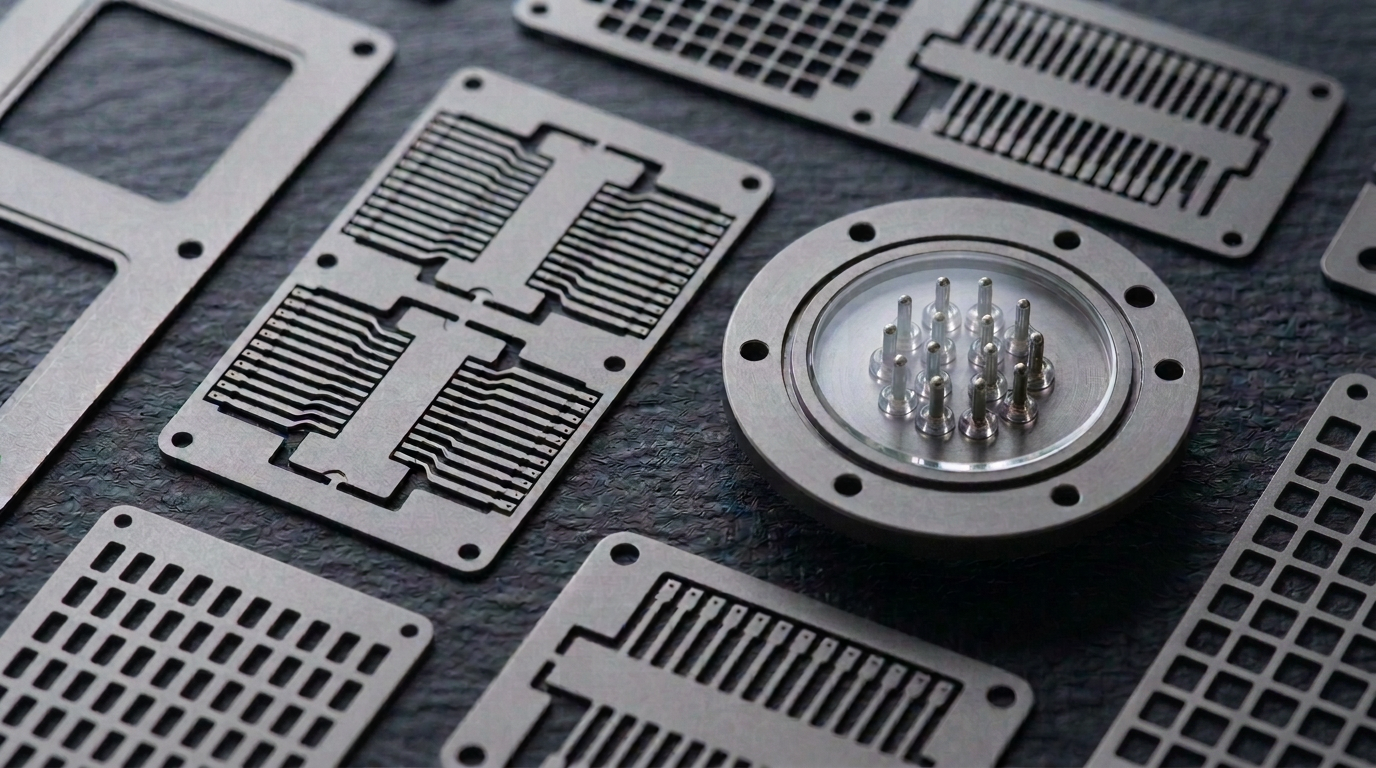
And the parts that need to be made from Kovar aren’t forgings or castings. They’re headers. Lids. Lead frames. Feedthrough flanges. Step covers for hybrid packages. Thin, flat, intricate components with tight tolerances, because the whole point is to seal them to glass or ceramic with zero stress. These are exactly the parts that fight you hardest during conventional machining.
So, back to the obvious question: will it etch?
Yes. Kovar is an iron-based alloy, and it responds well to ferric chloride etchant. The work-hardening that makes it so difficult to machine is completely irrelevant in a chemical process. In practice that means:
- Thicknesses from 0.001” to 0.040”. The range that covers headers, lids, lead frames, and feedthrough components.
- Burr-free, every time. Critical for sealing surfaces. A burr on a hermetic seal flange is a leak path.
- Zero mechanical stress. No work-hardening, no residual stress, no distortion. The CTE you spec’d is the CTE you get.
- Complexity is (basically) free. A step lid with 20 lead openings costs the same per piece as a plain cover.
- No hard tooling. Phototooling is generated from your CAD data. Design changes don’t mean new dies.
The real punchline
Kovar is a one-trick alloy, but it’s the only alloy that does that trick. The parts it makes are precision-critical, thin, and intolerant of stress. Conventional machining fights you on every one of those requirements. Photochemical etching doesn’t. Send us the print. We’ll tell you what we can do with it.
Verdict: Kovar does etch.
Have an etching need or challenge for our team? Request a quote or talk to a specialist.